Detecting absence: querying for the events that never happened

I have written more "check if X hasn't happened in N minutes" pollers than I care to admit. A timer-triggered Function, a state table to remember the last time you checked, some dedup logic so you don't page the same person twice, and a nagging feeling that the poll interval itself is a bug waiting to happen (miss the window and the alert arrives late, or not at all). It works, but it is infrastructure you built to answer a question your database should just be able to answer on its own.
Drasi, a CNCF Sandbox project for continuous queries over changing data, handles a question SQL cannot express well: "alert me when something stops happening." I have been testing it against a real AKS cluster and Azure Database for PostgreSQL.
The polling tax
"Alert me if a device hasn't checked in for 20 minutes" sounds like a simple requirement until you have to build it. The honest version needs a poller running on a schedule, a query for max(last_seen) per device, a state table so you don't re-fire the same alert every poll cycle, and careful handling of the boundary between polls (a device that goes quiet at minute 19 of a 20-minute check shouldn't wait an extra cycle to be noticed). None of that logic is about the business problem. It compensates for a normal query's inability to identify an event that failed to occur during a time window.
Drasi's standing queries flip this. You write the query once, and the result set is always current, maintained continuously as the underlying data changes, rather than recomputed on a schedule.
The left side is every poller I have ever written, and that's the set of problems that sold me on this. The right side is the same requirement with the scaffolding gone, no timer, no state table, no dedup logic. The result set is the state now, it maintains itself, and for absence specifically a pair of temporal functions carry the whole thing.
The function toolbox
| Function | Signature | Semantics |
|---|---|---|
drasi.trueFor | trueFor(expr, duration) | expr must stay true continuously for duration from the change time before an added result fires |
drasi.trueLater | trueLater(expr, timestamp) | evaluates expr at a future timestamp, returns drasi.awaiting meanwhile and re-schedules |
drasi.trueUntil | trueUntil(expr, timestamp) | expr must remain true until timestamp |
drasi.slidingWindow is documented (it's in the official Drasi custom functions reference), but it is not registered at the pinned 0.10.0 platform release. I wrote a query against it expecting an aggregation over a trailing window, and got UnknownFunction("drasi.slidingWindow") back instead, a hard failure, not a silent no-op. If you want a trailing-window aggregation today, you'll need to check the function actually exists on your pinned release before you build anything on top of it, the documentation is ahead of what 0.10.0 actually ships.
While trueLater waits for its scheduled timestamp, it returns the special value drasi.awaiting, so the result set holds rows that have not resolved yet. I tested this against a live cluster, and the behaviour is specific to trueLater: a trueFor row stays hidden until the debounce window elapses and never surfaces in an awaiting state. Conflating the two makes reaction logic treat a normal pending row as a bug.
Worked example: the silent sensor
The pattern that sold me on the whole model is the "device gone quiet" query, because it has to do two things at once: catch devices that are already overdue when the query is created, and schedule a future check for devices that will go quiet later.
MATCH (d:devices)
WHERE drasi.trueLater(
      datetime() >= datetime(d.lastseen + 'Z') + duration({ minutes: 20 }),
      datetime(d.lastseen + 'Z') + duration({ minutes: 20 }))
RETURN d.id AS id, d.lastseen AS lastseen
The + 'Z' appends the timezone marker. PostgreSQL's timestamptz columns arrive over the wire as offset-less ISO strings (2026-08-26T05:35:41.699091, no timezone marker), and feeding one directly into datetime() throws FunctionError: InvalidFormat because it requires an RFC 3339 string. The first bad row terminal-errors the whole query. Appending the offset before parsing fixes it.
Still chasing this one, so treat it as an open question rather than a fix: after this query had been running cleanly for a while, I inserted and then deleted a device row on the same table, and recreating the query afterwards hit the identical datetime error against rows that had parsed fine for hours. My working theory is that once a row in a CDC-tracked table goes through a live streaming-replication event, the source's cached representation of its timestamptz values can flip from offset-less to offset-included, which would silently break the + 'Z' fix. I haven't nailed the root cause yet. If you hit this, check whether the affected table has had any live inserts or deletes since the query last bootstrapped cleanly.
Worked example: unacknowledged alert escalation
The silent-sensor pattern schedules one future check per device. The second half of absence detection is the sustained condition: not "has it gone quiet," but "has this been true for too long." That is a different function, trueFor, and it is the difference between escalation-as-a-query and escalation-as-a-workflow-engine:
MATCH (a:alerts)
WHERE a.severity = 'P1'
  AND a.acknowledgedby IS NULL
  AND drasi.trueFor(
        a.severity = 'P1' AND a.acknowledgedby IS NULL,
        duration({ seconds: 60 }))
RETURN a.id AS id, a.severity AS severity, a.raisedat AS raisedat
trueLater puts a row in the result set at a future moment; trueFor keeps a row out until a condition has held continuously. One schedules and the other debounces. Together they cover absence detection.
I tested this with a shortened 60-second window rather than a real SLA, purely to see the transition without waiting around. ALR-100, a P1 alert with nobody assigned, entered the result set only once the full 60 seconds of continuous truth had elapsed, never before. Use whatever duration your actual SLA needs, the mechanism doesn't care.
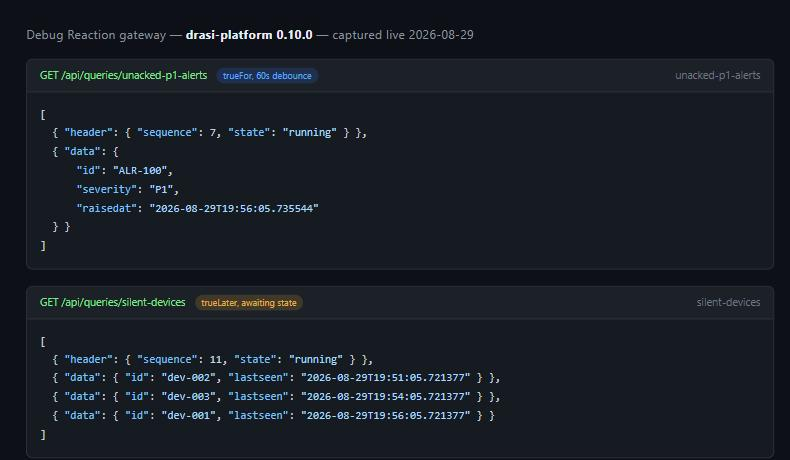
Both results above came straight off the Debug Reaction gateway (GET /api/queries/{id}) against a live cluster, not a docs example. The three devices sitting in the silent-devices result set are the trueLater awaiting state in practice, present in the result well before their 20-minute deadlines, each carrying its lastseen value so a reaction can show useful context rather than a bare row.
Once this is wired up correctly, here's the behaviour you should actually see, and what tells you something's wrong if you don't. unacked-p1-alerts stays empty the entire time an alert is unacknowledged but young, gains a row the instant the debounce window elapses, and never gains a row at all if someone acknowledges it first. If a row appears immediately on creation, your trueFor isn't debouncing, check the duration argument. silent-devices should show every device currently being tracked, each one sitting quietly with its real lastseen timestamp, awaiting rather than absent, right up until its 20-minute deadline actually passes. If a device is missing from the result set entirely rather than present-and-awaiting, that's the sign something upstream of the query, not the query itself, has gone wrong.
Gotchas from a live build
Each of these cost me a debugging round against a real Azure PostgreSQL Flexible Server and AKS, so here they are up front rather than buried in a support thread somewhere:
- Grant ordering. Running
GRANT SELECT ... ON ALL TABLESbefore the tables exist grants nothing to anything created afterwards. Bootstrap then fails withpermission denied for table. timestamptzarrives as an offset-less ISO string. Covered above,datetime(col)alone throws and terminal-errors the whole query.- The 0.10.x PostgreSQL source manages its own filtered publication (
rg_<source-name>), in addition to any you create yourself. It needs, in order,CREATE ON DATABASE, table ownership (for publication membership, which itself needsGRANT drasi_user TO admin), andCREATE ON SCHEMA publicfor the new owner. Bootstrap works fine without any of this, streaming just dies silently, which is the trap. wal_level=logicalis a static Postgres parameter. ARM reportsvalue=logicalthe instant you set it, but the running server stays onreplicauntil a full restart. Symptom: bootstrap succeeds, zero changes ever stream, and slot creation fails with "logical decoding requires wal_level >= logical."- The server admin login doesn't have the
REPLICATIONattribute by default, even as a member ofazure_pg_admin. Point a source straight at the admin login (rather than a dedicated replication role) and it fails with a different error again,FATAL: permission denied to start WAL sender. Fix:ALTER ROLE <login> WITH REPLICATION;. - Deleting a row can crash the entire reactivator, not just the affected query. Postgres's default
REPLICA IDENTITYonly sends primary-key columns in a DELETE's old-row image, everything else arrives asnull. Drasi generates a message schema mirroring yourNOT NULLconstraints, so a legitimately-null column in that DELETE event fails the generated schema's own validation and takes the whole connector down (Invalid value: null used for required field, thenCrashLoopBackOff). RunALTER TABLE <table> REPLICA IDENTITY FULL;on any watched table withNOT NULLcolumns outside the primary key, before you ever delete a row from it. drasi applyis not an upsert. Re-applying an existingContinuousQueryreturns500 Internal Server Error, and it blocks every other document in the same multi-doc file from applying. Delete, then apply.- Default providers are auto-registered. Older guidance saying source and reaction providers need a separate apply step after
drasi initis stale for the current CLI generation, I watched them register automatically during init.
When not to do this
Standing queries are the wrong tool for high-frequency flapping conditions on their own, a raw absence check on something that oscillates rapidly will fire constantly. Combine it with trueFor to debounce rather than alerting on every raw transition, the escalation example above is really that same pattern applied to alert acknowledgement.
That's enough to go and swap a poller for a standing query. The gotchas above are the ones that cost me actual debugging rounds, so hopefully they read as a head start rather than a repeat of the same wall.