Ingress and edge design decisions for API Management

Today, we are going to look at ingress and edge design decisions for Azure API Management (APIM).
This post captures the tradeoffs between three patterns:
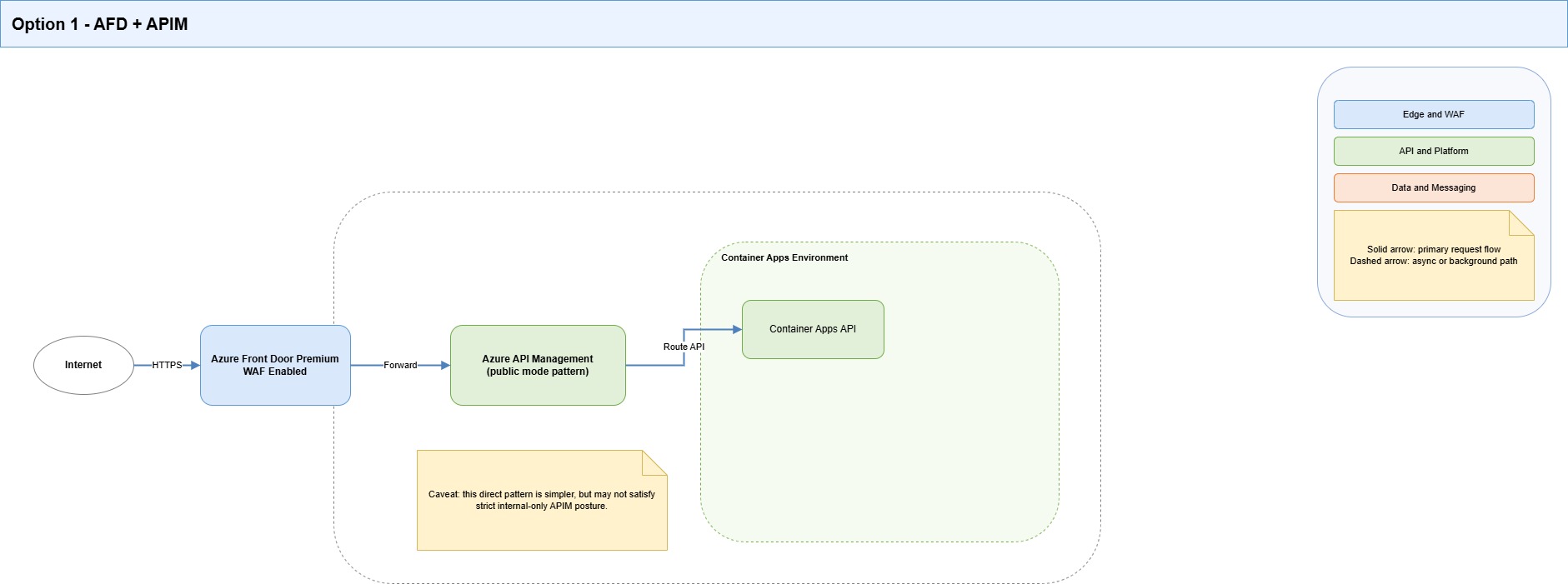
- Azure Front Door (AFD) + WAF -> Azure API Management (APIM)
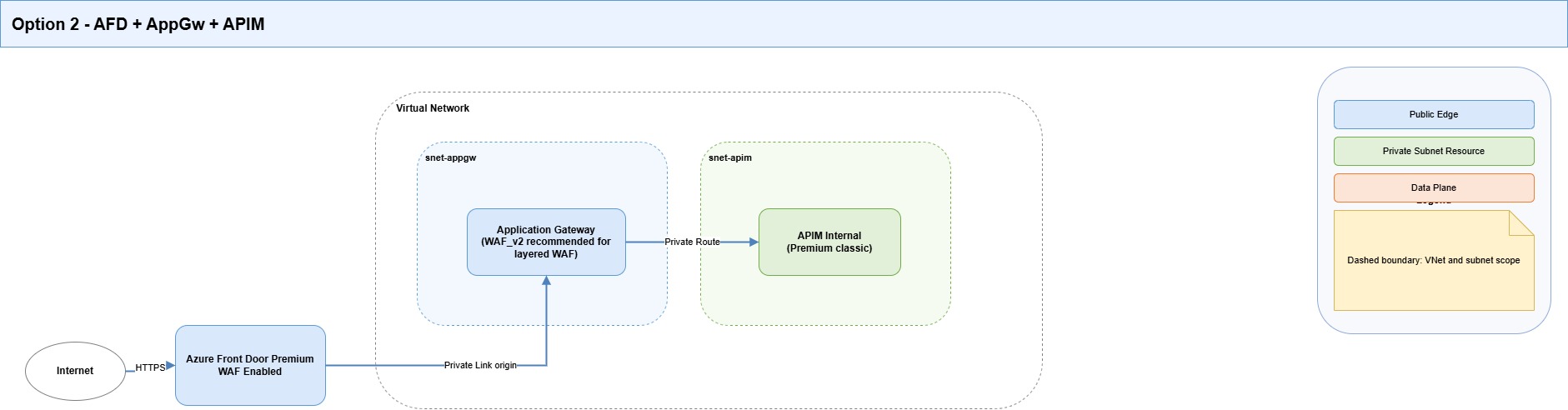
- Azure Front Door (AFD) + WAF -> Application Gateway (AppGw) -> Azure API Management (APIM) (internal)
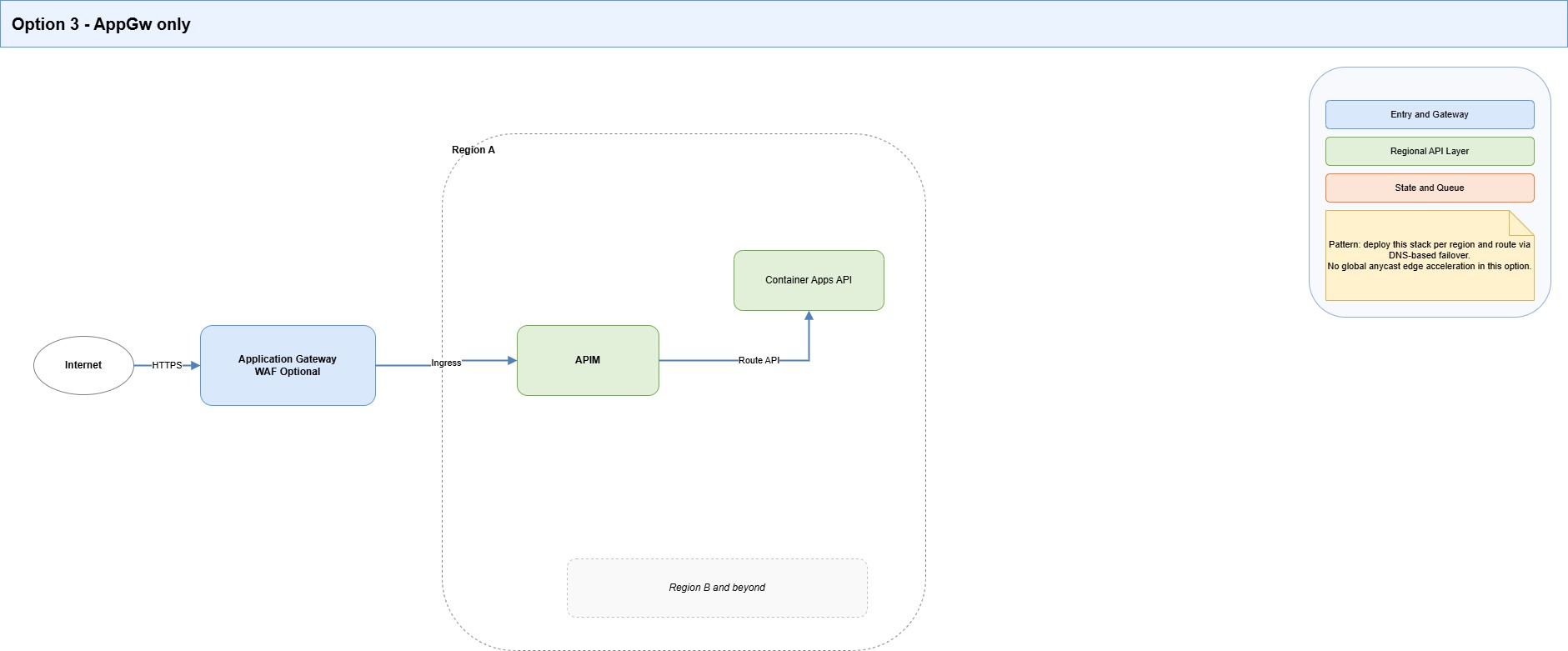
- Application Gateway (AppGw) -> Azure API Management (APIM)
The goal here is not architectural purity. It is to pick a pattern that survives real operations: DNS behavior, health probes, private-link approval flow, certificate lifecycle, and failure domains.
Scope and assumptions
- Azure API Management (APIM) is the API gateway and policy control plane.
- Workloads run in private-first Azure networking patterns.
- We need a secure public ingress with predictable operations.
- We care about a clear blast radius when things fail.
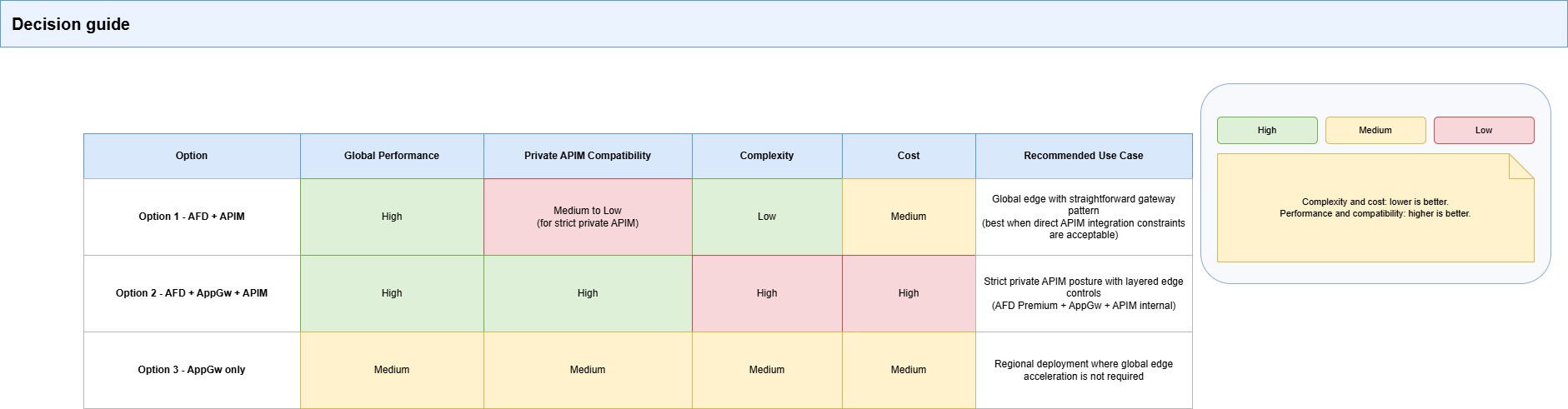
The options we are comparing today:
| Option | Best for | Main benefits | Main costs and risks |
|---|---|---|---|
| AFD + WAF -> APIM | Global edge with fewer components | Global anycast edge, strong DDoS posture, edge WAF, easier failover pattern | Can conflict with strict private APIM posture depending on tier and ingress constraints |
| AFD + WAF -> AppGw -> APIM (internal) | Strict private APIM with global edge | Preserves global edge and WAF, keeps APIM internal, supports private hop pattern | Highest complexity, more probe/policy coordination, higher cost |
| AppGw (+ optional WAF) -> APIM | Regional ingress use cases | Simpler than dual-edge, strong regional ingress control | No global POP acceleration, no native global failover orchestration |
SKU boundaries that matter
| Service | SKU | What matters | Caveat |
|---|---|---|---|
| Azure Front Door | Standard | Global edge, routing, rules engine, custom domain TLS | Private Link to origins is not supported in Standard |
| Azure Front Door | Premium | Private Link to supported origins, WAF, bot protection | Public and private origins cannot be mixed in the same origin group |
| Application Gateway | Standard_v2 | L7 routing, autoscale, static VIP | No WAF policy enforcement |
| Application Gateway | WAF_v2 | Standard_v2 + WAF policy | Needs active tuning to reduce false positives |
| APIM (classic) | Developer | Internal VNet mode for dev/test | No SLA, not for production |
| APIM (classic) | Premium | Internal VNet injection, private endpoint support, multi-region | Higher cost and ops overhead |
| APIM (v2) | Standard v2 / Premium v2 | Faster deployment/scaling, modernized platform | Multi-region currently unavailable in v2 tiers |
APIM + Front Door private-link caveat
Current guidance for Front Door Premium -> APIM via Private Link has two constraints that matter here:
- It is not supported with APIM Premium v2.
- In the referenced guidance for classic tiers, APIM is expected in public mode (not internal VNet mode).
For strict private APIM posture, AFD Premium -> AppGw (Private Link) -> APIM internal remains the safer and more operable pattern.
Zone redundancy (ZRS/AZ) and multi-region context
This part matters because "high availability" means different things depending on the service.
Azure Front Door (AFD)
- Front Door is a global edge service by design (POP-based), so you don't configure regional ZRS for Front Door in the same way as regional services.
- Resiliency is mostly achieved through origin design: multiple origins, health probes, and priority/weight routing.
- If using Private Link origins, include region-level redundancy in origin design to reduce dependency on a single regional path.
Application Gateway (AppGw) v2
- App Gateway v2 is a regional service.
- In regions with Availability Zones, it supports zone-redundant deployment (or zonal pinning if explicitly configured).
- This improves intra-region resiliency, but it does not replace cross-region design.
Azure API Management (APIM)
- Classic Premium supports multi-region deployment.
- v2 tiers currently do not support multi-region deployment.
- Premium v2 supports modern platform capabilities, but if a strict APIM multi-region is required today, classic Premium remains the stronger fit.
Design implications for this architecture
If your target is both:
- strict private APIM posture, and
- strong regional plus cross-region resilience,
Then the practical pattern remains:
- Front Door for global ingress and failover orchestration,
- per-region App Gateway (zone-redundant where available), and
- APIM in a tier/topology that matches the required multi-region behavior.
This is why topology decisions here are tightly coupled to SKU capabilities and lifecycle constraints.
What I learned when attempting various architectures
1. Complexity concentrates at the private boundary
The hardest part was not APIM policy authoring. It was making ingress topology and private-network behavior line up under real-world conditions.
Most failure patterns occurred around:
- DNS alignment
- private endpoint approval and propagation timing
- health probe and host-header mismatches
- certificate subject/SAN assumptions
2. To keep APIM private while still allowing public API access, use the architecture standard: AFD -> AppGw -> APIM (internal)
This gives clear separation of concerns:
- AFD = global edge + edge WAF + internet entry
- AppGw = regional ingress bridge into private network
- APIM = API governance and policy enforcement
3. Probe and host-header design must be explicit
Most 5xx incidents we saw were traceable to a probe path/protocol mismatch, a host-header mismatch, or a TLS name-check mismatch.
In this pattern, probe design is an architecture concern, not a post-deployment tweak.
4. Operational sequencing is not optional
Private endpoint approval and control-plane propagation timing can block otherwise-correct configurations.
Pipelines should include checks and retries for pending approvals, health state, and staged route transitions.
Decision guidance
Choose AFD + APIM when
- You need a global edge and WAF.
- APIM does not need a strict internal-only posture.
- Your selected APIM tier/topology supports your direct Front Door integration path.
- You want fewer moving parts.
Choose AFD + AppGw + APIM (internal) when
- APIM must remain private/internal.
- You still need global edge entry and WAF.
- You want stronger network boundary control.
- Your team accepts higher operational complexity.
Choose AppGw-only when
- The system is mainly regional.
- Global edge acceleration and failover are not requirements.
- Simpler operations are more valuable than global edge capability.
Security, reliability, and cost implications
Security
- AFD WAF gives early filtering at the global edge.
- AppGw adds regional boundary control (and optional second WAF layer with WAF_v2).
- APIM remains policy authority (authN/authZ, quotas, transformations, governance).
Reliability
- AFD improves global client experience and failover orchestration.
- AppGw introduces another health domain (more control, more misconfiguration surface).
- Internal APIM increases isolation but requires disciplined DNS and connectivity operations.
Cost and complexity (general)
- AFD + APIM: lower complexity than dual-hop.
- AFD + AppGw + APIM: highest control, highest ops overhead.
- AppGw-only: lower global capability, often lower cost than dual-hop.
TLS and certificate decisions
Does Front Door manage certificates?
Yes, for Front Door frontend custom domains.
- Azure-managed certs are supported and auto-rotated when validation conditions are met.
- BYOC is supported through Key Vault-backed secrets.
- BYOC can auto-rotate when configured to use
Latestsecret version.
Important boundary: Front Door-managed certificates do not manage certificates on downstream hops.
Certificate ownership by hop
- Client -> Front Door: AFD managed cert or BYOC
- Front Door -> AppGw: AppGw origin cert must be valid and host-name aligned
- AppGw -> APIM: backend cert trust chain and host validation must align
- APIM -> backend: backend-owned certificates and validation remain backend-side
mTLS decisions
Client -> Front Door
Front Door Standard/Premium does not support client mTLS at the edge.
Client -> APIM
APIM supports client certificate validation via policy (validate-client-certificate) and is the right enforcement point when certificate identity is required.
APIM -> backend
Use certificate-based controls where a stronger service-to-service identity is needed.
Tradeoff: mTLS increases certificate operations overhead but provides stronger identity assurance than token-only patterns.
Practical policy for an Integration platform
- Use Front Door-managed certificates by default for edge domains where suitable.
- Use BYOC when strict CA control, wildcard, or certificate pinning requirements exist.
- Keep HTTPS on all hops.
- Introduce mTLS at APIM ingress for partner/system integrations requiring certificate identity.
- Treat probe host headers, DNS records, and certificate subjects/SANs as one design unit, and validate them together per environment.
Recommendation
Use AFD + WAF -> AppGw -> APIM (internal) as the default production pattern while a strict private APIM posture remains a requirement.
Keep APIM as the single API governance control plane, and AppGw as the private ingress bridge.
If requirements change and strict internal APIM is no longer required, re-evaluate to reduce the number of layers and operational overhead.
References
- Connect Azure Front Door Premium to an Azure Application Gateway with Private Link
- Integrate API Management in an internal virtual network with Application Gateway
- Web Application Firewall (WAF) on Azure Front Door
- Quickstart: Create an Azure Front Door using Azure CLI
- Domains in Azure Front Door (certificate requirements)
- TLS encryption with Azure Front Door
- Configure HTTPS on an Azure Front Door custom domain
- Validate client certificate policy (APIM)
- Secure your origin with Private Link in Azure Front Door Premium
- Azure Front Door tier/service comparison
- What is Azure Application Gateway v2?
- What is Azure Web Application Firewall on Application Gateway?
- Feature-based comparison of Azure API Management tiers
- Azure API Management v2 tiers overview
- Connect Azure Front Door Premium to Azure API Management with Private Link